Are We Fighting the Wrong Enemy?
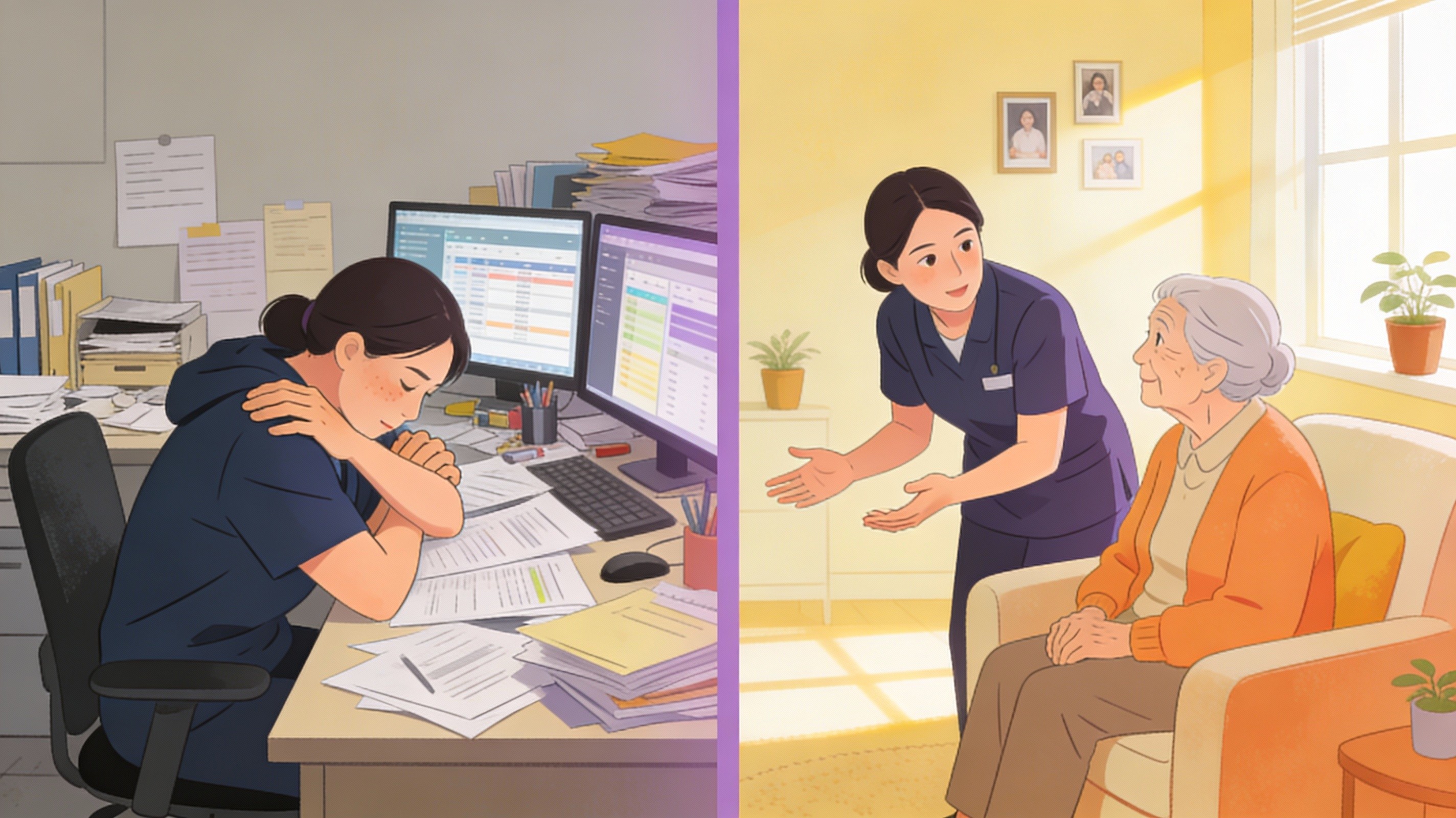
You've heard the story a thousand times: technology will solve everything. In aged care and home care, that line has worn thin. Families watch their parent's caregiver rush from one appointment to the next, clipboard in hand, pen perpetually in mouth, documenting more than actually seeing. Care workers describe nights spent handwriting care notes after their shifts end. Managers watch as experienced carers burn out not from the care itself—but from the suffocating load of paperwork, scheduling conflicts, and digital systems that multiply, rather than simplify, their work.
Here's what we're getting wrong: we've positioned technology as the enemy. But what if the real enemy is actually administrative burden? What if AI and compassion technology, when designed correctly, could give care back to humans instead of replacing them?
The data is staggering. In Australia, 94% of unpaid caregivers report being physically or mentally exhausted due to their responsibilities. Meanwhile, clinical staff across the country spend approximately 13 hours per week on general administrative tasks—time they'll never have with the people they care for. In one Ontario-wide study of primary care clinicians, over 70% reported burnout directly tied to administrative overload. This isn't a people problem. This isn't even a care problem. This is a systems problem—and systems problems have technological solutions.
But the solution isn't more complexity. It's radical simplification through intelligent automation. What we're seeing emerge in late 2025 and into 2026 is a fundamentally different approach: compassion technology that doesn't ask carers to work harder with more tools, but rather hands back the time they've lost to bureaucracy.
How Intelligent Automation Restores the Human in Care
Consider what happened in Sydney at Green Square Health when they implemented AI-powered document management. Previously, the clinic was processing over 100 medical documents daily, a task that consumed hours of administrative staff time. After introducing AI agents designed to automatically sort, allocate, and categorize documents, the same volume now completes in less than 50 minutes—with an average processing time of just 30 seconds per document. What matters isn't the efficiency metric. What matters is what staff did with those reclaimed hours: they spent them on actual patient interaction, community outreach, and care coordination that had fallen to the wayside.
In Victoria, similar technologies have compressed six-hour administrative tasks into 30 minutes. In Northern NSW, a single receptionist processed 42 documents in seven minutes. These aren't theoretical improvements. They're real hours returned to real people—time that can now be spent on phone conversations with anxious family members, on noticing the subtle changes in a patient's condition that trigger early intervention, or simply on the work of caring, which is fundamentally relational.
The broader clinical evidence is equally compelling. When AI scribes were introduced to Australian primary care settings, participating clinicians reported a 69.5% reduction in documentation time during clinical encounters. But perhaps more meaningful than time savings are the wellbeing outcomes: over 55% of clinicians using AI tools reported reduced stress levels and improved job satisfaction. One finding stood out: clinicians saved an average of three additional hours per week on after-hours administrative work, meaning they could close their laptops at the end of the day instead of working late into the evening.
This matters because burnout isn't a luxury problem—it's a crisis with systemic consequences. When care workers are depleted, they leave the sector. When they're overwhelmed by systems, their capacity for the emotional labour of care diminishes. The irony is that by trying to measure and optimize every aspect of care through rigid documentation and compliance systems, we've actually made care worse. We've transformed what should be a relational exchange—a neighbor helping a neighbor—into a transaction drowning in paperwork.
Compassion technology flips this script. It's built on the recognition that artificial intelligence should augment human capability, not replace it. At its core, compassion technology operates within a framework of six elements: Awareness of suffering, Understanding its context, Connecting with the person in pain, Making a judgment about what's needed, Responding with intention to alleviate that suffering, and finally, observing the effects of that response. Notice that none of these steps are performed by an AI. All of them are performed by a human—but now, a human whose time isn't stolen by administrative burden.
This is what leading organizations across Australia are recognizing. Tunstall Healthcare, a major provider of connected care solutions, articulates it plainly: "AI doesn't replace human carers—it augments their capabilities". The company designs systems where intelligent monitoring detects falls risk or unusual behavioural patterns, but the response remains entirely human. A carer using AI insights might spend more time listening to a resident's story, addressing the emotional and psychological roots of behavioral change, rather than logging data into disparate systems.
The regulatory environment is shifting to support this approach. Australia's Aged Care Act 2024 places person-centered care at the center of compliance and quality standards. The government has invested $1.4 billion in aged care technology infrastructure, with the explicit goal of enabling "care that is safer, more connected, more transparent and more person-centred than anything the sector has previously delivered". New frameworks like the Business-to-Government (B2G) systems are designed to reduce administrative burden on providers, freeing resources for actual care delivery.
Yet the transformation requires a fundamental mindset shift. Technology isn't brought in to measure and control care more intensely. It's brought in to eliminate the busywork that prevents authentic care. When a home care coordinator's AI assistant handles document allocation, scheduling conflicts, and routine patient calls, that coordinator can focus on what they're actually trained and passionate about: understanding the nuances of each person's situation, coordinating complex care journeys, and building trust with families.

What This Means for You
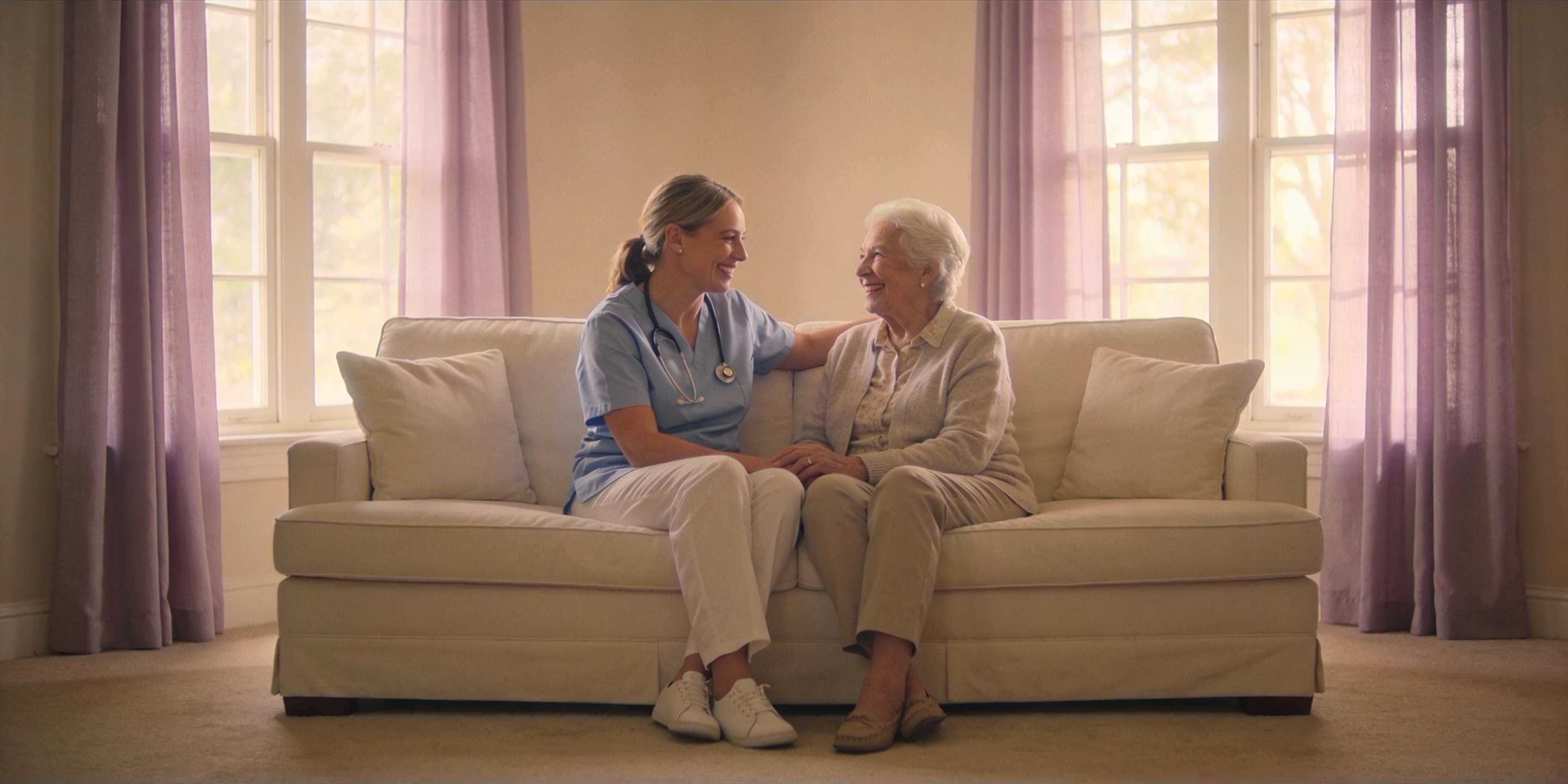
Your parent's caregiver could have genuine presence instead of divided attention. When AI handles administrative overload, care workers reclaim hours weekly for meaningful interaction, physical assessment, and emotional support—the irreplaceable elements of quality care.
Burnout in the care sector might finally reverse. With documented stress reductions and improved job satisfaction from early AI implementations, technological solutions designed around human wellbeing could stem the exodus of experienced carers leaving the profession.
Trust in technology can coexist with skepticism about commodification. Compassion technology isn't about replacing the human touch; it's about defending it—by protecting carers' capacity to care and refusing to let bureaucratic burden erode the relational foundation of care work.
The future of care might look less like a 5-star rating marketplace and more like a community ecosystem. When systems are designed to support rather than surveil, when technology serves relationships instead of metrics, care returns to what it's always been: mutual aid between people who know and trust each other.
Australia is leading this shift right now. Government investment in person-centered technology, sector-wide adoption of AI-powered coordination tools, and a regulatory framework emphasizing relational care mean that the next generation of Australian care could model what authentically human-centered, technology-supported care actually looks like.
Human connection isn't the luxury that gets cut when we optimize for efficiency. It's the foundation upon which care is built. Compassion technology recognizes this. And when designed with care workers' wellbeing and care recipients' dignity at its center, it doesn't threaten that foundation—it protects it.