
Is Australia Choosing Scale Over Care?
Somewhere between policy reform and market forces, Australia's care sector is making a choice—not consciously, but structurally. The choice is happening in boardrooms and compliance departments, in merger negotiations and funding applications. And it's a choice that directly contradicts what the government just legislated.
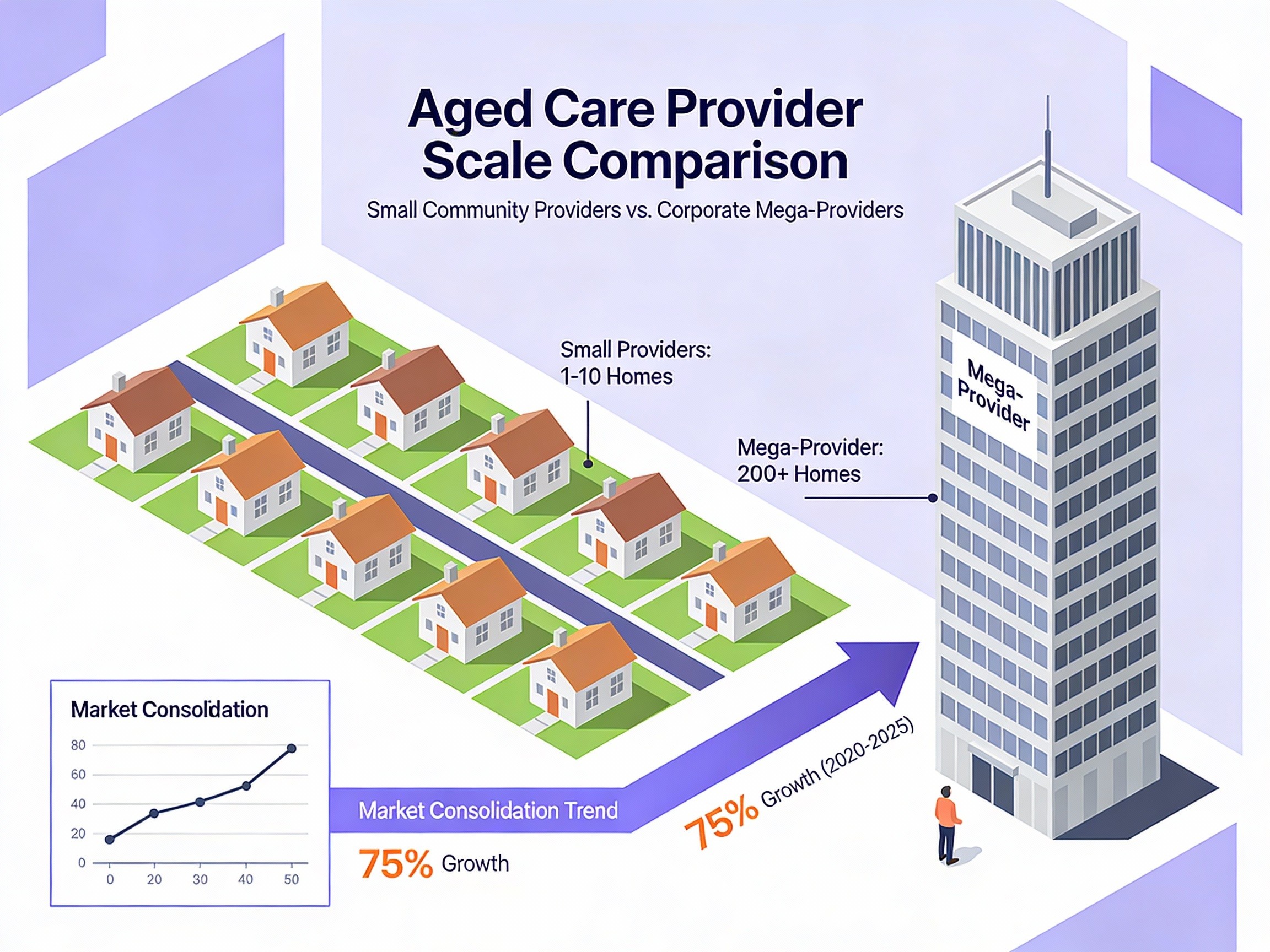
In January 2026, for the first time in Australian history, the idea of a 200-home aged care operator is no longer theoretical—it's emerging as the likely future shape of the industry. Meanwhile, thousands of kilometers away, the Royal Commission's recommendations and the newly implemented Aged Care Act 2024 are demanding something entirely different: person-centered care that honors each individual's unique identity, culture, beliefs, and life experiences. These two forces are on a collision course, and your aging parents are caught in the middle.
The consolidation is accelerating. The top 25 residential aged care providers now operate 44.7% of all residential care places—a figure driven by strategic acquisitions, smaller providers exiting due to regulatory burden, and a systematic squeeze on community-based and not-for-profit operators. What's being lost in this consolidation isn't efficiency or medical capability. It's something far more fundamental: the relational substrate that makes care actually work. It's the neighborhood knowledge, the family connections, the cultural understanding, the accountability to community. It's the very thing CareNeighbour exists to defend.
Why Bigger Isn't Better in Care
The logic seems sound on paper. Consolidate, achieve scale economies, invest in systems and technology, standardize care protocols, and you'll deliver better, more efficient care. But care isn't a widget. The evidence from comparable sectors—and increasingly from aged care research itself—reveals a troubling pattern: when care organizations get larger and more corporate, relational quality declines.
Research into Australia's childcare sector, which follows a parallel market structure to aged care, found something stark: corporate chains delivered the lowest quality care on all measured dimensions. Community-based centers? They consistently outperformed on the measure that matters most for vulnerable populations the ability to develop individual relationships with the people in their care. Corporate centers had only one-quarter of staff saying they had time to develop individual relationships with children, compared to half of staff at community-based centers. When you scale to 200 homes, you inevitably move toward corporate center logic: standardized protocols, efficiency metrics, and relational care as a secondary priority.
The Australian aged care sector is replicating this consolidation pattern exactly. Small services declined by 29% over recent years, with not-for-profit providers hit hardest at 32% decline. Meanwhile, private for-profit providers are strategically positioning themselves in higher-margin sectors like retirement living, abandoning smaller communities and regional areas where population density doesn't justify mega-provider economics. The result? Regional and rural aged care is increasingly reliant on smaller, community-based, and culturally specific providers and those providers are disappearing.
Why? Because the regulatory and financial environment has made it nearly impossible for them to survive. The new Aged Care Rules 2025 require "extensive documentation" and "overly complex" compliance procedures, imposing "significant financial and workforce impost" on providers. Todd Yourell, CEO of regional NSW provider St Andrews Village Ballina, warned plainly: "Without recalibration, the Rules risk accelerating service closures, reducing residential bed supply and undermining access to care, particularly in regional Australia". Larger operators can absorb these compliance costs. Smaller ones cannot. Consolidation accelerates.
But here's where the contradiction becomes critical: the very Aged Care Act 2024 that's driving this consolidation mandate the exact opposite approach. Outcome 1.1 explicitly requires that "partnerships and personal relationships are at the centre" of aged care delivery. It demands that providers understand each person's identity, culture, ability, diversity, beliefs and life experiences—not as demographic data, but as the foundation of individualized care. This isn't a suggestion. It's now law. And mega-providers, by structural necessity, cannot deliver this at scale. They can try—with person-centered software and care plans but the relational foundation that makes person-centered care real is absent when you're managing 200 homes.

Relational Care Works Better
Beneath all the policy complexity and market dynamics sits research that should be shaping Australia's care future—but isn't. Research showing that caregivers in family-dominant networks had significantly lower caregiver burden and greater positive aspects of caregiving than those in isolated or limited networks. Research showing that care network characteristics are critical to older adults' ability to age in place to stay in their communities rather than transitioning to institutional care. Research demonstrating that families with strong resilience and collaborative support networks show improved health outcomes across generations.
The implication is revolutionary: the traditional informal care network family, neighbors, community isn't a liability to be replaced by professional systems. It's the actual medicine. A mega-provider might deliver more efficient care protocols. But it will never replace the health benefits of a diverse, coordinated, relational care network.
Consider what's happening with workforce. Australia's aged care sector faces a shortage of 35,000 workers this financial year alone, with projections of 120,000 additional workers needed by 2035. The government massively underestimated this shortage because it miscalculated how long individual care tasks actually take in the real world. But the more urgent crisis is burnout. Nearly a third of aged care workers plan to quit within three years; half within five years. The top reasons? Stress, excessive overtime, and too much paperwork.
Here's what consolidation doesn't solve: these are structural problems of how we're organizing care, not just scale problems. Mega-providers don't solve burnout; they often entrench it. Staff in larger organizations face more rigid hierarchies, less autonomy, more documentation, and weaker relational connection to the care mission. By contrast, staff in not-for-profit providers receive above-award wages at 95% of large organizations, compared to just 64% in large for-profits. Not-for-profits also achieve higher retention rates suggesting that community-based, mission-driven organizations actually solve workforce problems better than consolidated entities.
The aging in place evidence is equally compelling. Complex multifactorial care models those that are person-centered, address both health and social needs, include comprehensive assessment and care planning, and are delivered by multidisciplinary clinical teams—have the most consistent evidence for supporting older people to age in place. Notice what this model requires: integration, coordination, and deep understanding of the individual. Notice what it cannot be: standardized, protocol-driven, institutionalized. It's the opposite of mega-provider logic.
Yet Australia is moving toward consolidation anyway, not out of evidence but out of regulatory and financial necessity. Smaller providers can't survive the compliance burden. Private for-profits see better margins in retirement living than in regulated aged care. Not-for-profits, constrained by community accountability and mission, lack the capital to scale. The system is mechanically pushing toward mega-providers, regardless of evidence.