Reclaiming the 40,000-Hour Deficit
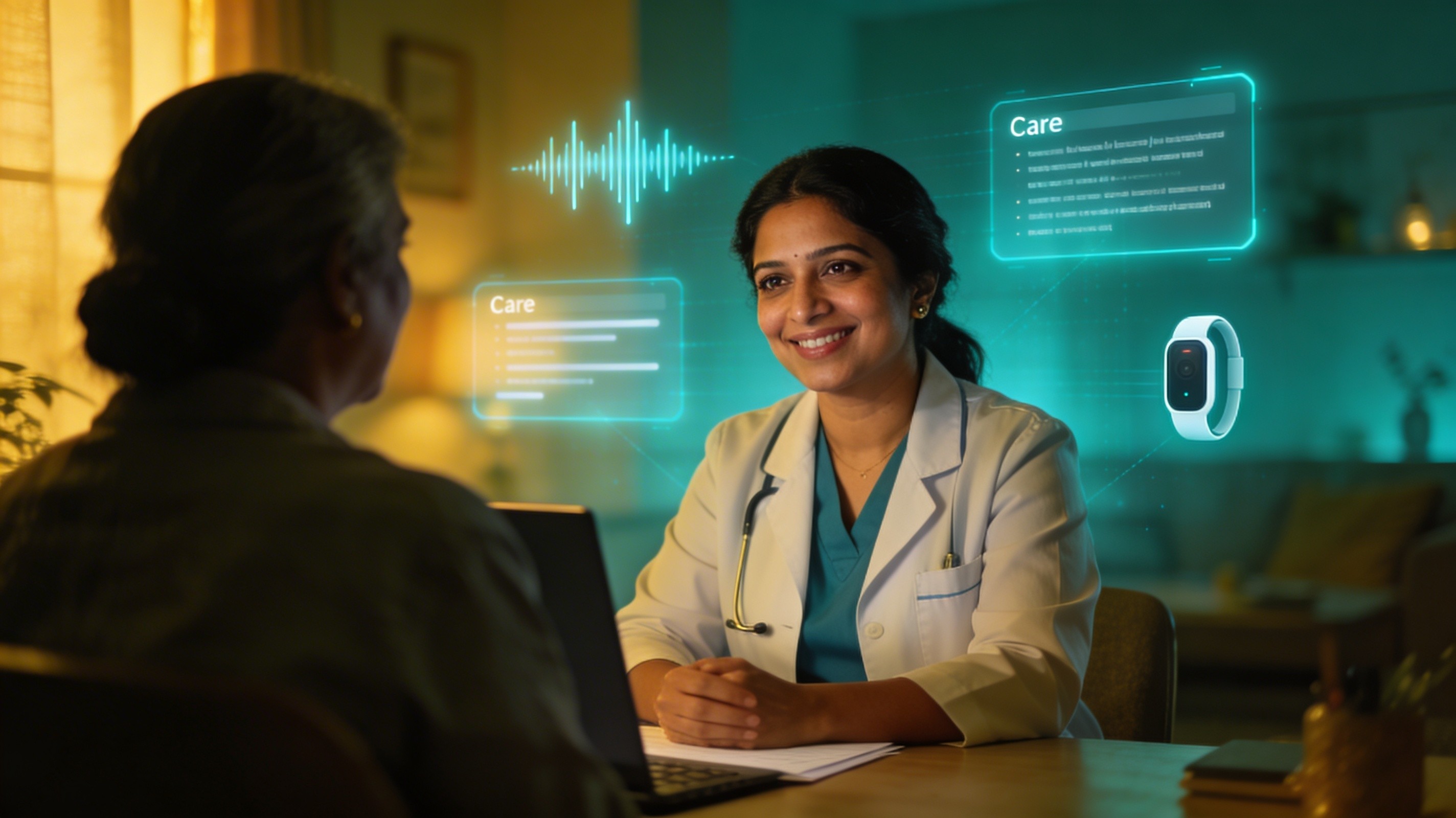
One of the most visceral burdens on the modern clinician is "Pajama Time"—the unpaid, late-night hours spent on clinical documentation. In 2026, high-performing agencies treat this exhaustion not as a byproduct of the job, but as a primary enterprise risk.
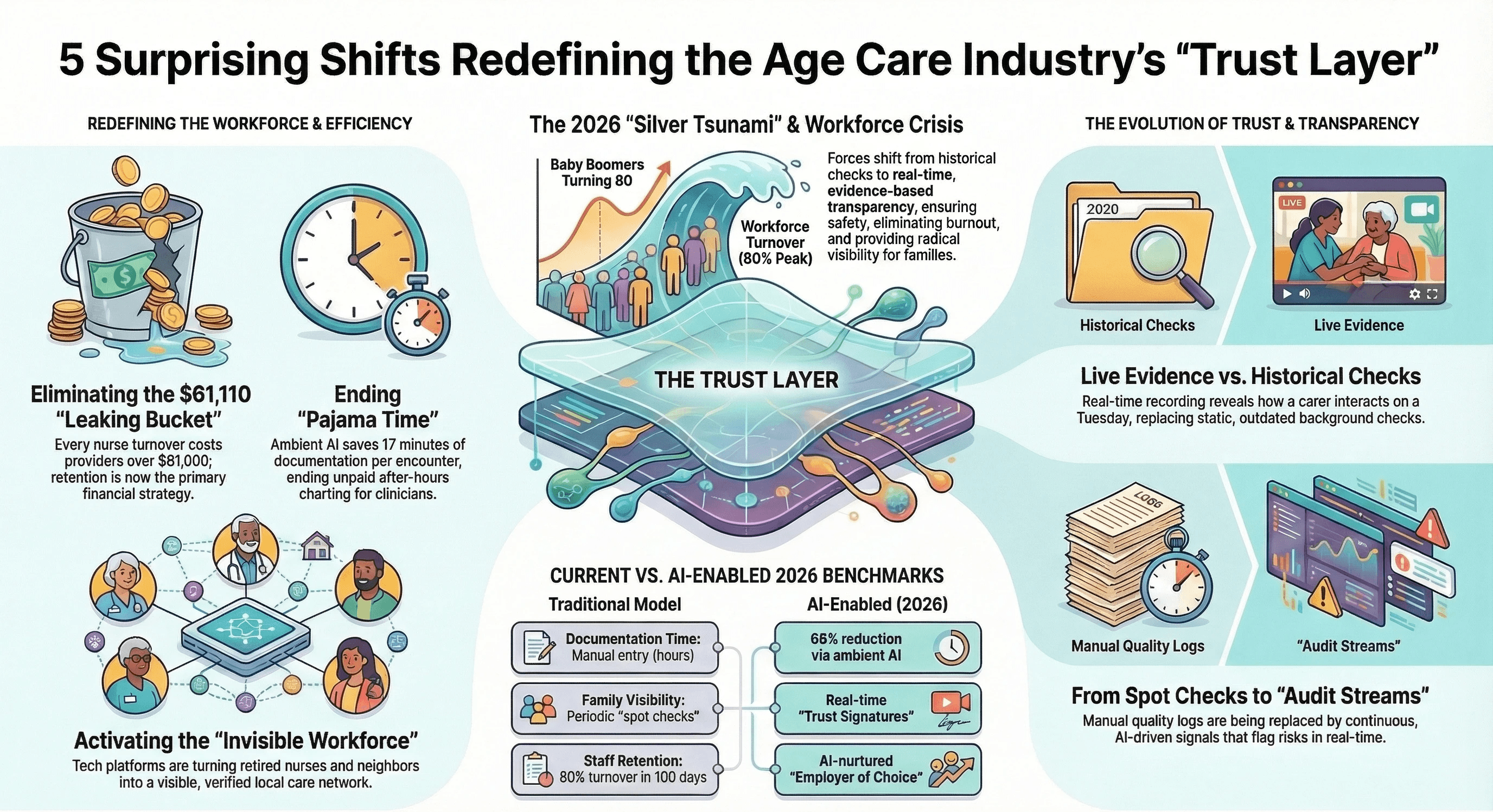
Ambient AI has emerged as the antidote, reducing documentation time by 60% to 68%. For the average provider, this saves 66 minutes daily. When scaled across an agency of 100 clinicians, this buys back over 40,000 hours annually. This is fundamentally a retention play: by eliminating the administrative "digital leash," 90% of clinicians report they can finally give patients their undivided attention, up from a pre-AI baseline of 49%.
"We launched a unique initiative to return 10 million clinician hours back to patient care over the next few years. This not only improves efficiency but also supports retention and wellbeing." — Mark Whalen, Executive Vice President and Enterprise Chief Strategy and Transformation Officer, Jefferson Health
The Demographic "Fulcrum" and the Modern Caregiver’s Dilemma
2026 is the definitive demographic fulcrum. As the first wave of Baby Boomers reaches age 80, the "Silver Tsunami" has transitioned from a forecasted warning to a structural reality that traditional labor models can no longer support. This shift arrives amidst a brutal economic divergence: global healthcare costs are rising at 10.9%, effectively decoupling from a general inflation rate of 3.7%.
In 2026, the mandate is no longer negotiable: shift to verified prevention or face insolvency. For care providers, the primary constraint is no longer capital—it is workforce stability. With clinicians exiting the field in record numbers, technology has moved from an "optional upgrade" to an "essential retention strategy." We have reached the end of the era of "reactive rescue," where agencies survived on premium labor and emergency hiring. The industry’s new "Trust Layer" is built on the intersection of human empathy and agentic technology, moving us toward a future of continuous, data-validated care.
Why Operational Empathy is the New Revenue Engine
The "hamster wheel" of emergency hiring is a fiscal disaster. In 2026, "Operational Empathy"—the use of digital tools to provide predictable scheduling and administrative relief—is a core risk strategy. The industry has finally acknowledged the $61,110 truth: that is the average cost of a single RN turnover. With 80% of new hires quitting within their first 100 days, stabilization is the only path to protecting margins.
The Cost of Inaction: A "leaking bucket" of talent resulting in an average annual turnover loss of $4.75 million for acute care hospitals and a heavy reliance on volatile agency labor.
The Return on Stability: A "Rule of 40" performance driven by reduced mortality rates, shorter lengths of stay, and the preservation of institutional knowledge.
2026’s "Stealth" RPM Codes
2026 marks the year CMS finally bridged the "adherence gap." Previously, the "16-day rule" (CPT 99454) penalized agencies for patients with inconsistent monitoring. The 2026 Physician Fee Schedule introduced "Stealth" codes that acknowledge 2–15 days of data as clinically actionable. These codes allow for "micro-interventions" that match the actual speed of care rather than arbitrary documentation thresholds.
Code | Description | Estimated Reimbursement |
|---|---|---|
99445 | Device + data capture for 2–15 days in a 30-day period | ~$47 |
99470 | Brief RPM mgmt: first 10 minutes + 1 live interaction | ~$26 |
By validating short-term monitoring for post-operative recovery or medication titration, these codes remove the financial risk of uncompensated data, making Remote Patient Monitoring (RPM) a scalable reality for the first time.
Moving to "Systems of Action"
While 80% of AI initiatives previously failed as "flashy pilots," 2026 focuses on "Agentic AI" systems that coordinate tasks across clinicians and families rather than just providing static insights. This is the solution to the "Human-AI Synergy Gap", the disconnect between rapid tech deployment and the workforce’s ability to integrate it.
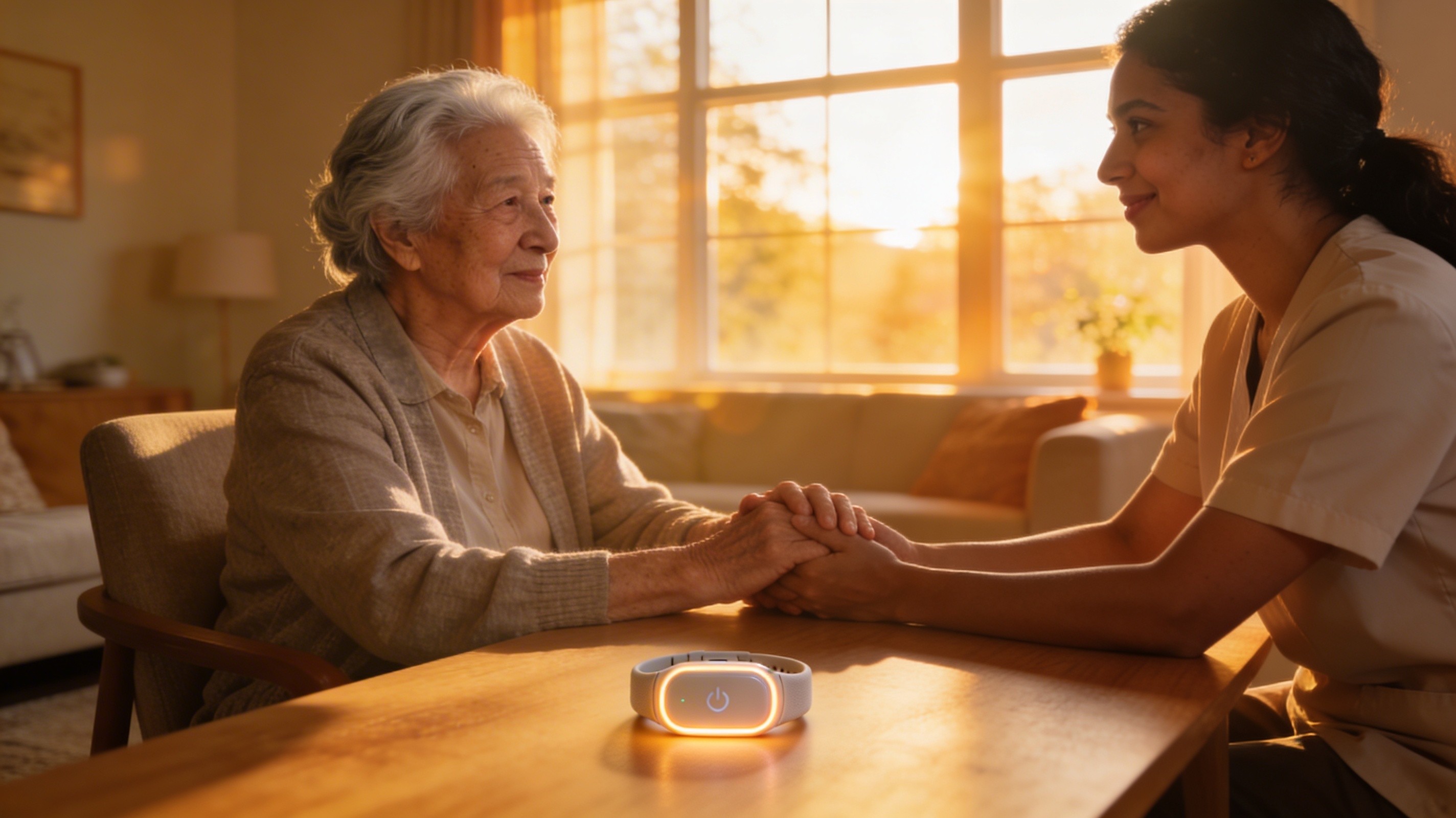
At CareNeighbour, we utilize a "Wearable-First" architecture. The device is a dual-microphone, BLE-enabled pod worn via a lanyard or clip that eliminates the "upload" friction. It ingests a single live audio stream to trigger Five Parallel Analysis Jobs:
Family Summary: Reassuring, non-clinical visit diaries for loved ones.
Carer Record: Professional session notes for the carer’s portfolio and coaching.
Provider Signal: Quality indicators, compliance flags, and medication alerts for the agency.
Trust Score: A rolling, behavior-based metric that builds a portable reputation for the carer.
Bookmarks: Summarized transcript segments of critical moments flagged by the carer via a physical button press on the device.
"The last two years were characterized by experimenting with AI, and now we will start to see wholesale job redesign... addressing the ‘Human-AI Synergy Gap’—the disconnect between the rapid deployment of agentic AI and the workforce’s ability to effectively integrate it." — Stephen Motew, MD, President and CEO, UF Health
The Question of Trust
As we navigate the demographic pressures of 2026, technology must serve as the bridge to independence, not a "digital leash." The future belongs to "Healthcare Without Walls," where data-validated care ratings and "smart-home sanctuaries" provide the ultimate safety assurance without sacrificing human dignity.
Ultimately, the industry’s success depends on whether we use these tools to amplify human empathy or merely to automate flawed processes.
In a world of ubiquitous AI, will your organization be defined by the algorithms it deploys, or by the human trust it manages to preserve?